this is roughly the post i wish i had when i was diving into discord a while ago and i had no idea what any terms meant relative to what i was used to in tumblr. there are probably better resources out there for this already. idk.
so from what i’ve seen in discord, you’ll usually have:
a server per partner. discord is mutual follows or bust, more or less
‘making a server’ may sound intimidating but the hardest part is deciding who’s going to do it and then coming up w/ a name tbh
rping without a server and inside discord dms is possible, just might just make ooc chat awkward. it’s basically rping in tumblr ims
after you make a server (big plus button on the left), you’ll need to send your partner an invite to it
at least one channel in the server for ooc chat (the default #general works well for this)
roughly a channel per thread overall
channel categories to organize things w/ if you want. not required. i’ve seen all sorts of permutations for ooc chats and ic threads across categories. a good starting point may be just “ooc” and “ic” categories. general chat and nsfw/inspo channels in the ooc category, and rp threads in the ic category. you can also do per-ship categories with channels (threads) within them
historically i think there’s been less focus on visuals as part of discord threads compared to tumblr. it was a bit more laid back because there’s not as much room for formatting in discord, and including images is a bit more awkward. that may change considering any exodus from tumblr to discord will be nontrivially centered around visuals ¯_(ツ)_/¯
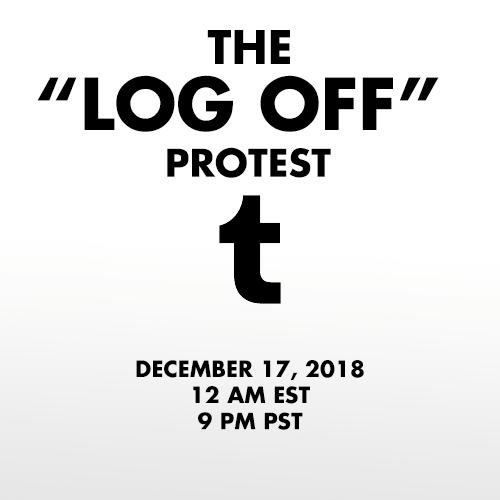
In response to the NSFW ban being enacted by Tumblr Staff, on December 17th 2018 I propose that we all log off of our Tumblr accounts for 24 hours.
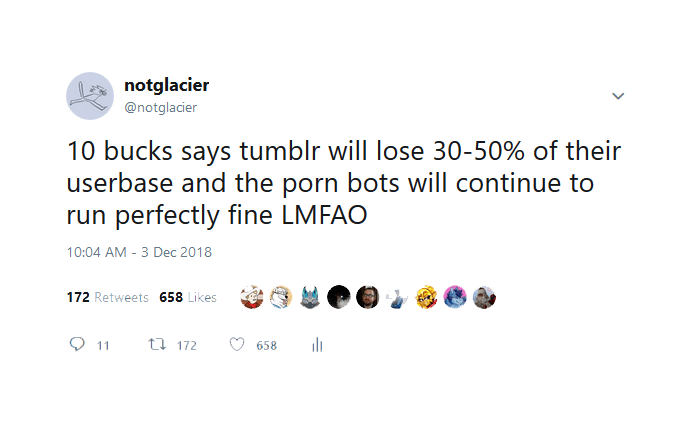
The lack of respect and communication between staff and users is stark. Users have been begging staff to delete the porn bot outbreak, which has plagued the website for well over a year. The porn bots oftentimes send people asks and messages, trying to get them to go to a website full of viruses. They also spam advertisements on others posts.
Users have also begged that Tumblr ban neo-nazis, child porn, and pedophiles, all which run rampant on the site. The site/app got so bad that it was taken off the app store.
However, instead of answering the users, Tumblr has instead taken the liberty to ban all NSFW content, regardless of age. But users have already run into issues of their SFW content being marked as sensitive and being flagged as NSFW, not allowing them to share their work.
Not only does this discriminate again content creators, but it also discriminates against sex workers. Disgustingly, the ban will be enacted on December 17 which is also International Day to End Violence Against Sex Workers.
This ban is disgusting, and while I (and plenty of others) welcome porn bots and child porn being banned, the Tumblr filtration system is broken. It tags artistic work’s nipples as NSFW (when it is art), it tags SFW art as NSFW (when it is not), and does not stop the porn bots, neo-nazis and dozens of other issues.
This ban is discriminatory. This ban is ineffective. This ban is unacceptable.
To protest, log off of your Tumblr account for the entirety of November 17th. Log off at 12 am EST or 9PM PST and stay off for 24 hours. Don’t post. Don’t log on. Don’t even visit the website. Don’t give them that sweet ad revenue.
Tumblr’s stock has already taken a hard hit. Let’s make it tank. Maybe then they will listen to the users.
Tumblr seems to be in potential death throes or at least, incredibly volatile and unreliable lately, but we’ve done some pretty good and informative work on canon analysis and reference guides so I was looking for ways to back it up without losing it…and the solution became obvious to me:
Archive of Our Own, aka AO3.
“What?” you might ask if you are less familiar with their TOS. “Isn’t that just a fanfic archive??”
No! It’s a fanWORK archive. It is an archive for fanworks in general! “Fanwork” is a broad term that encompasses a lot of things, but it doesn’t just include fanfic and fanart, vids etc; it also includes “fannish” essays and articles that fall under what’s often called “meta” (from the word for “beyond” or “above”, referencing that it goes beyond the original exact text)! The defining factor of whether Archive of Our Own is the appropriate place to post it is not whether or not it’s a fictional expansion of canon (fanfic), though that is definitely included – no, it’s literally just “is this a work by a ‘fan’ intended for other ‘fannish’ folks/of ‘fannish’ interest?”
The articles we’ve written as a handy reference to the period-appropriate Japanese clothing worn by Inuyasha characters? The analyses of characters? The delineations of concrete canon (the original work) vs common “fanon” (common misconceptions within the fandom)? Even the discussion of broader cultural, historical, and geographic context that applies to the series and many potential fanworks?
All of those are fannish nonfiction!
Which means they absolutely can (and will) have a home on AO3, and I encourage anybody who is wanting to back up similar works of “fannish interest” – ranging from research they’ve done for a fic, to character analyses and headcanons – to use AO3 for it, because it’s a stable, smooth-running platform that is ad-free and unlike tumblr, is run by a nonprofit (The OTW) that itself is run by and for the benefit of, fellow fans.
Of course, that begs the question of how to tag your work if you do cross-post it, eh? So on that note, here’s a quick run-down of tags we’re finding useful and applicable, which I’ve figured out through a combination of trial and error and actually asking a tag wrangler (shoutout to @wrangletangle for their invaluable help!):
First, the Very Broad:
– “ Nonfiction ”. This helps separate it from fanfic on the archive, so people who aren’t looking for anything but fanfic are less likely to have to skim past it, whereas people looking for exactly that content are more likely to find it.
– while “Meta” and “Essay” and even “Information” are all sometimes used for the kinds of nonfiction and analytical works we post, I’ve been told “ Meta Essay ” is the advisable specific tag for such works. This would apply to character analyses, reference guides to canon, and even reference guides to real-world things that are reflected in the canon (such as our articles on Japanese clothing as worn by the characters). The other three tags are usable, and I’ve been using them as well to cover my bases, but they’ll also tend to bring up content such as “essay format” fanfic or fanfic with titles with those words in them – something that does not happen with “Meta Essay”.
– I’ve also found by poking around in suggested tags, that “ Fanwork Research & Reference Guides ” is consistently used (even by casual users) for: nonfiction fannish works relating to analyses of canon materials; analyses of and meta on fandom-specific or fanwork-specific tropes; information on or guides to writing real-world stuff that applies to or is reflected in specific fandoms’ media (e.g. articles on period-appropriate culture-specific costuming and how to describe it); and expanded background materials for specific fans’ fanworks (such as how a given AU’s worldbuilding is supposed to be set up) that didn’t fit within the narrative proper and is separated out as a reference for interested readers.
Basically, if it’s an original fan-made reference for something specific to one or more fanworks, or a research aid for writing certain things applicable to fanworks or fannish interests in general, then it can fall under that latter tag.
– You should also mark it with any appropriate fandom(s) in the “Fandom” field. Just like you would for a fanfic, because of course, the work is specifically relevant to fans of X canon, right?
If it discusses sensitive topics, or particular characters, etc., you should probably tag for those. E.g. “death” or “mental illness”, “Kagome Higurashi”, etc.
Additionally, if you are backing it up from a Tumblr you may wish to add:
– “ Archived From Tumblr “ and/or “ Cross-Posted From Tumblr ” to reference the original place of publication, for works originally posted to tumblr. (I advise this if only because someday, there might not be “tumblr” as we know it, and someone might be specifically looking for content that was originally on it, you never know)
– “ Archived From [blog name] Blog ”; this marks it as an archived work from a specific blog. And yes, I recommend adding the word “blog” in there for clarity- Wrangletangle was actually delighted that I bothered to tag our first archived work with “Archived From Inu-Fiction Blog” because being EXTREMLY specific about things like that is super helpful to the tag wranglers on AO3, who have to decide how to categorize/”syn” (synonym) various new tags from alphabetized lists without context of the original posting right in front of them. In other words, including the name AND the word “blog” in it, helps them categorize the tag on the back end without having to spend extra time googling what the heck “[Insert Name Here]” was originally.
Overall, you should be as specific and clear as possible, but those tags/tag formats should prove useful in tagging it correctly should you choose to put fannish essays and articles up on AO3 🙂
Oh, and protip sidebar for those posting, especially works that are more than plain text: you can make archiving things quicker and easier for yourself, but remember to plan ahead for tumblr’s potential demise/disabling/service interruptions.
The good news: You can literally copy and paste the ENTIRE text of a tumblr post from say, an “edit” window, on tumblr, straight into AO3′s Rich Text Format editor, and it will preserve pretty much all or almost all of the formatting – such as bold, italics, embedded links, etc!
But the bad news: keep in mind that while AO3 allows for embedded images and it WILL transfer those embedded images with a quick copy-paste like that, AO3 itself doesn’t host the images for embedding; those are still external images. This means that whether or not they continue to load/display for users, depends entirely on whether the file is still on the original external server! As I quickly discovered, in the case of posts copied from the Edit window of a tumblr post, the images will still point to the copies of the images ON tumblr’s servers.
What this means is that you should back up (save copies elsewhere of) any embedded images that you consider vital to such posts, in case you need to upload them elsewhere and fiddle with where the external image is being pulled from, later.
Personally, I’m doing that AND adding image descriptions underneath them, just to be on the safe side (and in fairness, this makes it more accessible to people who cannot view the images anyway, such as sight-impaired people who use screen readers or people who have images set to not automatically display on their browser, so it’s win-win)





 TheWanderingSunset2